Why Cars Made The Switch To 12-Volt From 6-Volt Batteries - Jalopnik
Organic Media/Getty Images If the battery is a car's heart, the electrical architecture — its wires, electronic control units, sensors, and more — is its ca...

Organic Media/Getty Images
If the battery is a car's heart, the electrical architecture — its wires, electronic control units, sensors, and more — is its cardiovascular system. Similar to how the heart pumps blood around the cardiovascular system, the battery supplies current to the electrical architecture, and the voltage rating signifies the "pressure" of circulation.
park plugs for steady operation.
However, as engines grew in size, compression ratios climbed, and cars offered more electricity-sapping features in the 1950s, 6-volt batteries started struggling under the increased load and faced difficulties in engine-starting. So the industry moved over to 12-volt systems, which handled newer cars' electrical needs, were more cost-effective due to reduced wiring, and were more durable.
The rise and fall of 6-volt car batteries
jsmir/Shutterstock
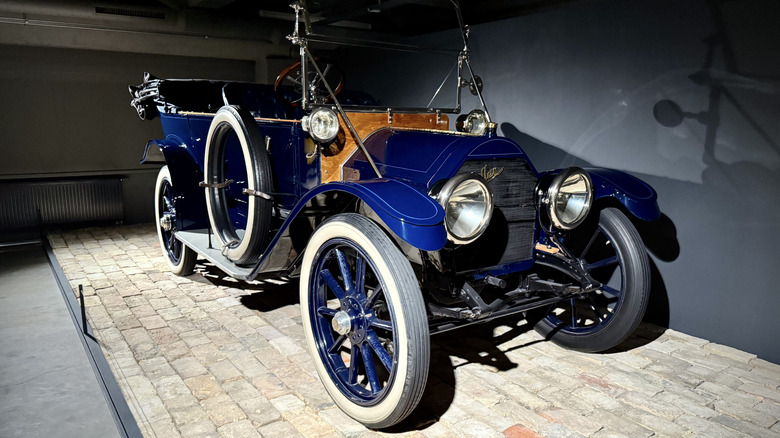
Six-volt batteries became the automotive standard not long after Cadillac debuted the electric self-starter in 1912, invented by Charles Franklin Kettering, in the Model 30 (pictured). It was the first American car to come fitted with a 6-volt electrical system, while Hudson became the first U.S. automaker to use a standardized 6-volt battery size per Battery Council International specifications in 1918.
From then until the 1950s, 6-volt electrical systems became prevalent in cars, but things changed quickly after World War II. As part of the postwar "horsepower race" that began in the early '50s, engines in American cars grew larger and sported higher compression ratios. Compression ratio is the volume of the engine's cylinder when the piston is at its lowest point divided by the volume when the piston is at its highest point. As the compression ratio rises, the piston increasingly resists rotation, which means the starter must work harder to crank the engine.
Six-volt starters were good for engines with compression ratios of 7:1 or lower, but in the postwar era, compression ratios were in the 8:1 to 10:1 range for mainstream cars, extending to 12:1 for some performance engines. And cars started coming with electrical fitments like powered windows, powered seats, air conditioning, electrical wipers, radios, and the like, further piling on to the 6-volt battery's already-heightened load.
By 1953, engine-starting issues began manifesting for some Chevrolet cars, with hot engines sometimes refusing to turn over because the 6-volt battery lacked sufficient cranking power for the higher compression. That year, General Motors began introducing 12-volt electrical systems for Cadillac, Buick, and Oldsmobile cars, and by 1955, every U.S. automaker had switched over to 12-volt batteries.
The benefits of 12-volt batteries
Dustypixel/Getty Images
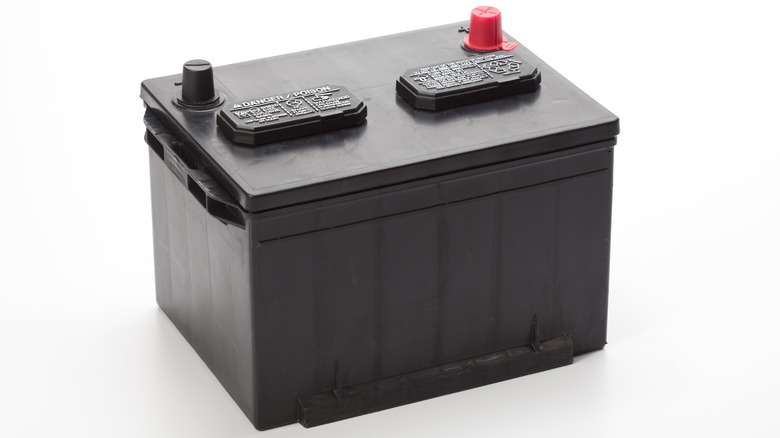
The core upside to using 12-volt batteries is rooted in physics, specifically the formula for calculating electrical power (P = V x I) that states an inverse relationship between voltage (V) and current (I). Per the formula, power is also directly proportional to voltage. This means engineers can increase the electrical power in a circuit by bumping up the voltage and reducing the current. Lower current enables engineers to use thinner wiring as well, thereby reducing copper usage and manufacturing costs.
Twelve-volt batteries offer more power during cranking compared to 6-volt ones, and even last a year or two longer — lower current means less voltage drop due to resistance (the natural pushback a wire or connection puts up against electricity flowing through it) at old or corroded connectors and switches. That matters because dropped voltage means less power reaching electrical components, which makes them malfunction or be unable to run at full strength. The benefits, therefore, were plentiful, and automakers redesigned their electrical systems and fitments to comply with 12-volt batteries.
Even today, 12-volt batteries remain the standard for internal-combustion passenger cars, though larger vehicles like trucks and buses have upgraded to 24-volt systems. Mild hybrid cars even use an auxiliary 48-volt battery to run heavier loads like electric compressors, energy regeneration while braking, integrated starter-generators, and more. EVs, meanwhile, use extremely-high-voltage electrical architectures — commonly 400 volts to 800 volts — to enable rapid charging speeds, improve efficiency, and reduce wiring weight.