5 Perfect ’80s Games Nobody Remembers That Need a Comeback
Follow Link copied to clipboard ...
Follow
Link copied to clipboard

Published Aug 16, 2026, 11:00 AM EDT
Unearth these classics from the 8-bit era
5 perfect '80s games nobody remembers — but they need a comeback
 Image: Hewson Consultants
The 1980s wasn't the decade video games were born; the origins of the medium go back a further 20 years, through the likes of Spacewar! and Pong. But it was in the 1980s that video games grew up, exploding in popularity and complexity and establishing many of their defining stars. It was the decade that gave us Mario and Zelda, Pac-Man, Final Fantasy, Prince of Persia, and SimCity. But it also gave us some much more obscure titles that have since fallen by the wayside. Here are five fantastic '80s games that might have been forgotten, but still have something to teach us.
1
Tempest
- 1981, Arcade
Dave Theurer's riveting Atari shooter is the game in this bunch you're most likely to have heard of, but it still represents one of video gaming's most compelling roads not traveled — an evolutionary branch that was never really developed, but that still stands out for its originality. Essentially, Theurer took the 2D plane of contemporary shooters like Space Invaders and Centipede and wrapped it into a tube which you then stare down in 3D, your craft clinging precariously to its lip as enemies crawl up at you. Etched in the sharp neon lines of a vector display, and controlled by spinning a wheel rather than tilting a stick, Tempest still feels futuristic 45 years later, and totally hypnotic.
If you're ever lucky enough to see an original Tempest arcade cab, you have to try it; it's like nothing else. If not, the good news is that UK game programmer Jeff Minter was so obsessed with Tempest that he made multiple remakes of it, authorized and otherwise, which are easier to find and play today, including the peerlessly trippy Tempest 2000 (included in this collection for current hardware).
2
The Lords of Midnight
- 1984, ZX Spectrum, Amstrad CPC, and Commodore 64
 Image: Beyond Software
Mike Singleton's fantasy epic was a kind of Skyrim of the '80s. Heavily influenced by The Lord of the Rings, it was a hybrid of a role-playing game, a strategy game, and the "graphic adventures" of the time. It gave the player remarkable freedom to explore its fantasy kingdom, recruit new party members, and amass troops to combat the forces of an evil witch-king who has cursed the Land of Midnight with a permanent winter.
The Lords of Midnight had a then-revolutionary "landscaping" presentation which allowed the player to freely explore Midnight in first-person. It looks very primitive now, moving around and changing orientation in single frames, like an outdoor Dungeon Master. But the eeriness of its setting, and the freedom the player is given in how to approach the campaign — by setting out on a solo adventure, by recruiting troops and making war, or both — are intoxicating even now.
3
Paradroid
- 1985, Commodore 64, Amiga, and Atari ST
Designed and coded by Andrew Braybrook, Paradroid is a sci-fi action game with a unique hacking mechanic. You could see it as the Pragmata of its time, but it's actually even cooler than that. On the face of it, it's a fairly simple puzzle-shooter with a top-down view in which your robot battles hostile automatons that have overrun a fleet of spaceships.
But, rather than vanquish the robots in battle — all more powerful than your own prototype Influence Device — you hack them via a logic-puzzle minigame and gain control of them, adopting their attributes as your own. You're not increasing the power of your own droid, but hopping from one robot to the next, using their power as stepping stones. As a progression system, it's incredibly ahead of its time.
4
The Sentry/The Sentinel
- 1986, BBC Micro, IBM PC, and other home computers
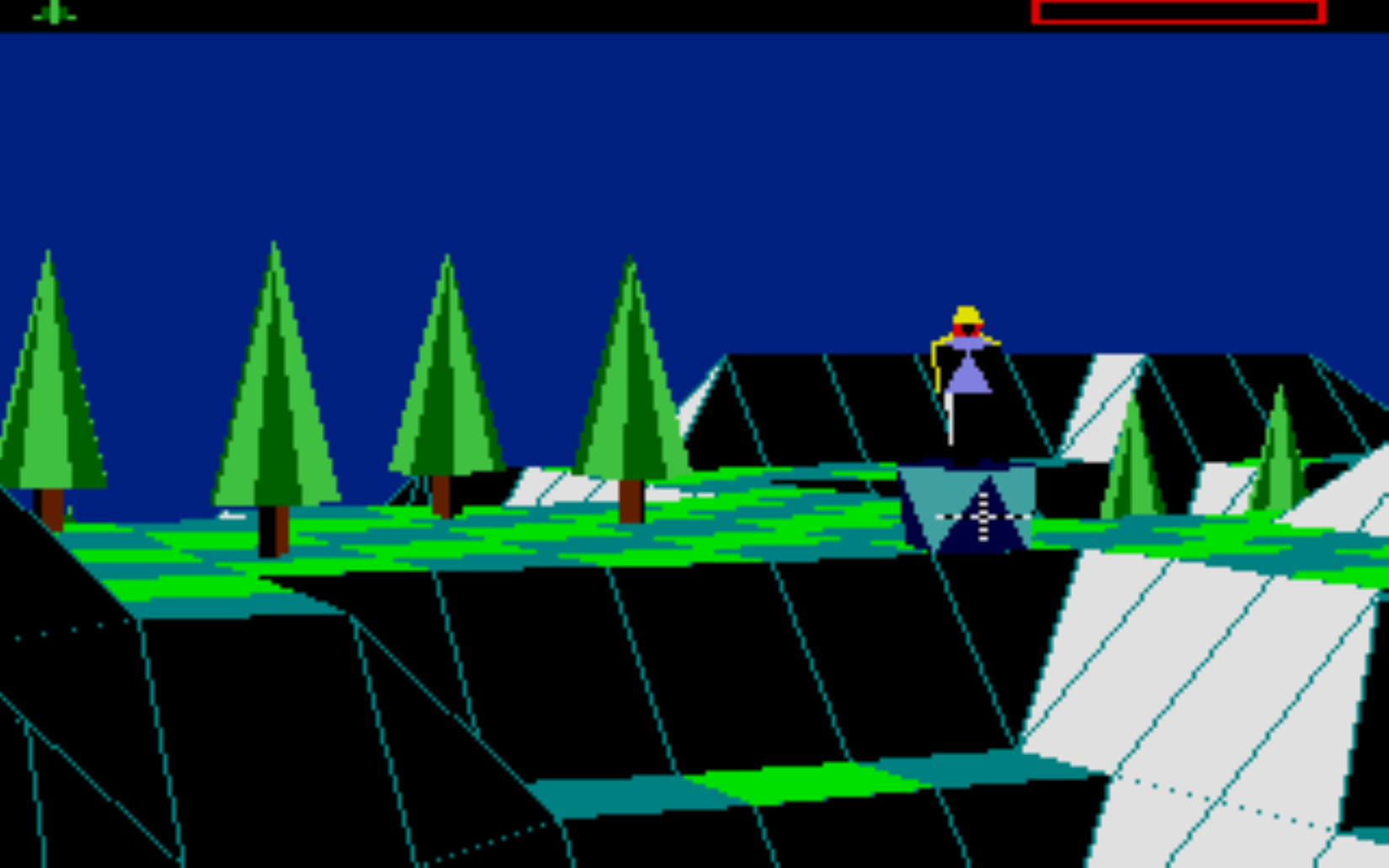 Image: Geoff Crammond/Firebird
Now this one is really far out. Its creator, Geoff Crammond, went on to become a founding father of sim racing with his Stunt Car Racer and Grand Prix series. Before that, he made this abstract puzzle-strategy game — a kind of sci-fi chess, played from first-person perspective inside one of the pieces, across randomized three-dimensional landscapes.
As in Paradroid, you're a telepathic robot, but this time your aim is to climb from the lowest point on the map to the highest, where the Sentinel — an ominous, watchful monolith — resides. Your robot can't move, but it can look around, absorb energy from objects in line of sight, and create clones of itself on higher ground to hop into. All of this must be done outside of the Sentinel's terrifying gaze. A total one-off; in 40 years, there's never been anything like The Sentinel.
5
Captain Blood
- 1988, Atari ST, Commodore Amiga, and other home computers
 Image: Infogrames
Captain Blood is perhaps the purest expression ever of the wild, non-conformist ambition of French video game design: a metafictional sci-fi epic about communication and ego death. You play a video game designer who gets sucked into his own spacefaring game, cloned 30 times in a hyperspace accident, and then spends 800 years hunting down his clones to regain his own personality. As the game starts, Captain Blood is down to the last (and toughest) five clones.
A big part of his interstellar hunt for the clones takes the form of conversations with alien species, which are conducted using an icon-based universal language. Meanwhile, Blood's health is deteriorating, which makes the mouse cursor shake and the game harder to control. Ubisoft's craziest moments are mere gestures toward the deranged genius of this Infogrames classic, designed by Philippe Ulrich and Didier Bouchon.