Don’t throw away your old Android tablet — do this instead - Engadget
Android Auto will run right on your tablet's screen with the Open Headunit app. ...
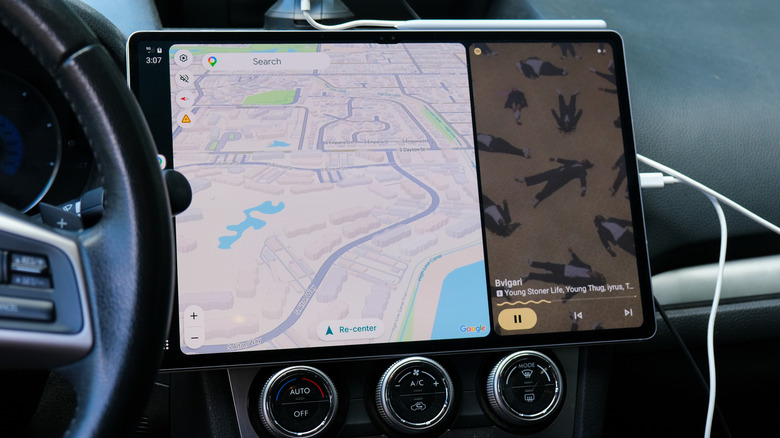
Android Auto will run right on your tablet's screen with the Open Headunit app.
Max Miller for Engadget
When a tablet gets old, it can often become nothing more than an expensive coaster. That's doubly true of Android tablets, which run the gamut from premium to ultra-budget in quality. Once they can no longer reliably run modern apps, Android tablets have few paths forward. They may be handy as e-readers or smart home control panels, but frankly you can probably find better ways to accomplish those tasks.
But one unexpected use for an Android tablet is as a head unit for Android Auto, using it to control your phone, navigate and play media on the go. Using the Open Headunit app, which costs just shy of $4 on the Google Play Store (though you can get it free from GitHub if you've got a bit more tech know-how), you can trick your phone into seeing your tablet as an Android Auto unit and displaying a big, car-friendly infotainment system right on the larger screen. It's not perfect, but after some extensive testing, I've concluded that it's a viable option for anyone whose vehicle doesn't support Android Auto by default, especially at a time when auto makers are increasingly halting Android Auto support.
Android Auto is a service that connects your phone with your car and displays a driving-friendly version of Android on your car's touchscreen infotainment system. It's a wonderful perk for drivers lucky enough to have a car that supports it, but many do not, especially older vehicles. If you're relying on a regular Bluetooth connection to your phone for navigation and entertainment, putting a tablet in your car as an Android Auto interface could be a significant upgrade.
Your tablet can become your car's infotainment system
Max Miller for Engadget
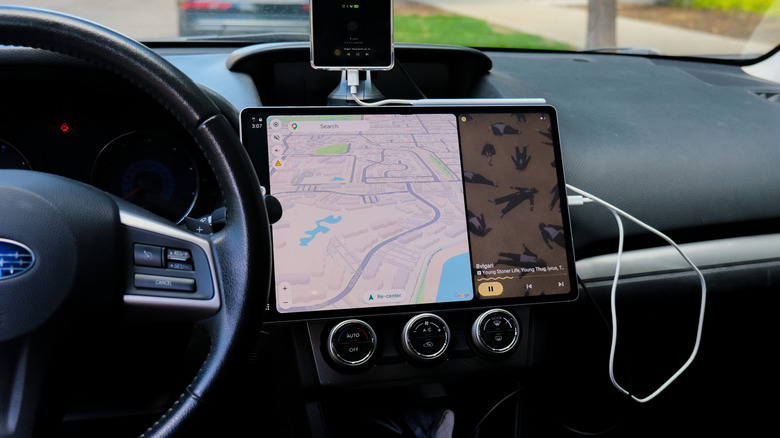
Getting the Open Headunit app running requires some fiddling. It allows multiple connection types — USB, Wi-Fi, Bluetooth and running Android Auto directly on-device if your tablet supports it — and you'll need to do some experimenting to figure out which plays nice with your combination of hardware. Additionally, you'll need to connect the tablet to your car's audio system in order to play music or other media through it. Open Headunit has a handy built-in configuration tool that will walk you through all the most important settings and adjust them to work with your setup. Gemini in Android Auto is supported, too.
In my case, the issues with wireless Android Auto got me good, and USB ended up being the easiest solution. Once I spent some time enabling all the various permissions for Open Headunit and making it the default for USB connections, plugging my phone into my Samsung Galaxy Tab S10 Ultra would reliably open Android Auto and resume playback on my Spotify through its speakers. Connecting the tablet to my car's Bluetooth allowed the audio to pipe through my car stereo, but that created too much latency. I was able to reduce the delay by using a small USB-C hub with a 3.5mm headphone jack, then wiring an auxiliary cable from that into my car's own 3.5mm jack.
Performance was great on my tablet, but it's a high-end unit only a couple of years old. Unfortunately, I was not able to test Open Headunit on older hardware. My ancient Nexus 7 from 2013 got stuck in a boot loop when I dug it out of storage, and a Galaxy Tab S6 Lite from 2019 experienced a display malfunction. Neither recovered by filing time. With that said, all the processing for this test was done on my phone, with the Open Headunit app simply fooling the phone into thinking the tablet is a car.
Open Headunit isn't a perfect replacement for built-in Android Auto
Max Miller for Engadget
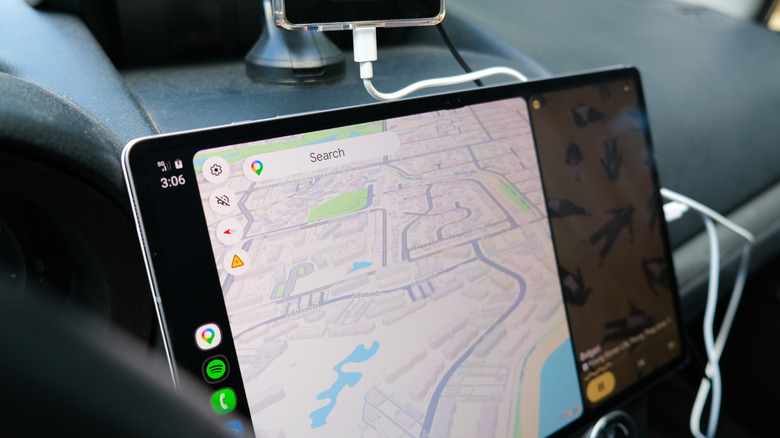
You might not want to leave a tablet visibly mounted in your car at all times, as even an older tablet may be a tantalizing target for thieves who don't know any better. Personally, my tablet pulls double-duty as my primary computing device, so if I stick with Open Headunit long-term, I plan to install multiple MagSafe car mounts in a row on my dash and stick multiple magnet rings on the backside of my tablet, hopefully supporting the weight of the device while I drive and allowing me to easily toss it back into my bag when I park. Or maybe I'll just grab one of the many car tablet mounts available on Amazon. For now, the tablet sits propped in the tray area below the car's actual head unit when I'm running Open Headunit.
Clearly, this is not a perfect solution. But it's a lot cheaper than buying a new head unit for Android Auto, especially if you already have a tablet. If your car's stock head unit has quirks that make it particularly aggravating to replace, Open Headunit is a decent way to avoid that experience altogether. The head unit in my 2015 Subaru failed a couple of years ago, and it would cost me over $2,000 to get it replaced by an official dealer. I could buy my own Android Auto head unit and install it myself, but after looking up some guides, it's not something I'll have time for in the near future. I'm just not that much of a car guy. In the meantime, this solution works well enough. And I have to admit, Android Auto is a very luxurious experience on a 14.6-inch, 2K AMOLED display.