Do tourists stress out safari animals? We tested their dung to find out
Every year, thousands of tourists pile into game drive vehicles or don their hiking gear and cross South Africa's nature reserves. Binoculars and cameras at the ready, each hopes for a special encounter ...
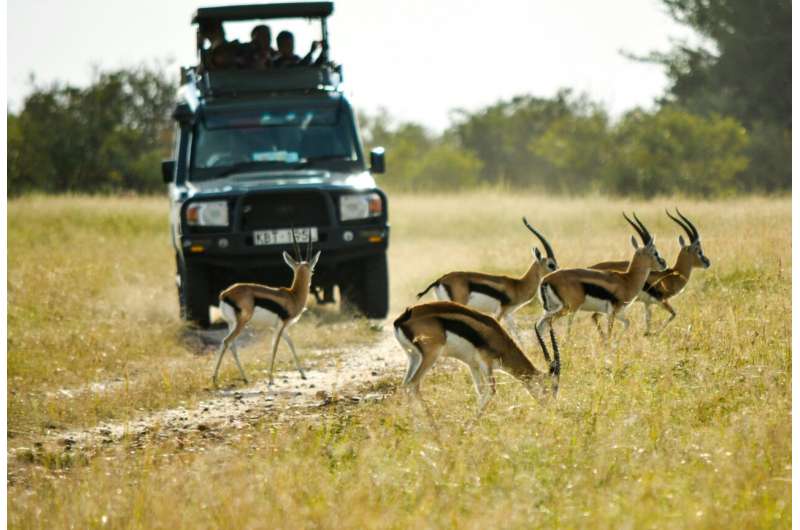
Every year, thousands of tourists pile into game drive vehicles or don their hiking gear and cross South Africa's nature reserves. Binoculars and cameras at the ready, each hopes for a special encounter with Africa's wildlife—as small as dwarf mongooses, as mighty as elephants or as elegant as giraffes.
Wildlife tourism is an industry worth hundreds of billions of dollars globally. The income from tourists is needed to pay for conservation. But a question has been asked: Are tourists stressing out the very animals they came to see?
It's a fair concern. As a researcher who studies wildlife stress responses, I was part of a team that set out to answer this scientifically, not just by watching animals and interpreting their behavior, but by measuring the animals' stress-related hormones.
We wanted to find out if tourist activity resulted in a stress response in impala, zebra, blue wildebeest and giraffe, some of the most commonly seen animals on safari.
We collected more than 500 dung samples from these animals over one year at Somabula Nature Reserve, a small, fenced reserve in Gauteng, South Africa. We then compared the animals' stress-related hormone levels found in the dung with the number of tourists visiting the reserve each day.
We collected samples during both the wet and dry seasons to find out whether changes in food availability and environmental conditions in the different seasons affected the animals' stress levels. We also divided our dung collection between samples collected during the week, when tourist activity was low, and over the weekend, when tourist activity on the reserve was much higher.
We found that plains zebra, blue wildebeest and giraffe did not have higher stress-related hormone levels due to increased tourist activity. Only impala did, and only in the dry season.
This showed that different animals respond to tourism pressure differently, and nature reserve managers need to adapt their conservation and tourism plans accordingly. For example, during the dry season, animals need areas in reserves where there are no tourists that they can escape to. In this way, species that are prone to stress from tourism pressure can have a break.
Finding facts in feces
Animals release stress-related hormones (also known as glucocorticoids) when they face predators or compete for food. Metabolites of these hormones are later passed out in their dung. Scientists can measure stress levels by collecting dung without disturbing the animals.
Across impala, plains zebra, blue wildebeest and giraffe, we found that the biggest causes of stress were natural challenges, not tourism. The changing seasons, breeding, and the availability of food and water had a much greater effect on stress-related hormone levels than the number of visitors in the park.
The way animals responded also differed from one species to another. Only impala had noticeably higher stress-related hormone levels on weekends than on weekdays, and only during the dry season. This is when the park is busiest with tourists, but it is also a tough time of year for wildlife because food and water are scarce.
Blue wildebeest, on the other hand, had higher stress-related hormone levels during the wet season. This is probably because many females are giving birth at this time, which places extra demands on their bodies. This makes the period particularly demanding for the animals, regardless of how many tourists are present.
Zebra and impala, by contrast, showed higher stress-related hormone measurements during the dry season, when there is less food and water and more competition for it inside a small, fenced reserve.
The seasons didn't affect stress levels for giraffe. However, females had much higher stress-related hormone levels than males, almost certainly because two of the five females we monitored were visibly pregnant during the study period. We know giraffe pregnancy is naturally accompanied by increases in glucocorticoids. This helps giraffe mothers supply continuous nutrients to the developing fetus and prepare for the physical demands of labor.
In other words, the animals' stress levels were mostly a response to the rhythms of their natural world rather than tourists.
There was one clear exception: impala. These smaller antelope are constantly alert for danger and are generally more cautious than the other species. During the dry season, they had much higher stress-related hormone levels on weekends, when the reserve has more tourists, than on weekdays. Impala stress-related hormone levels were approximately 57% higher on weekends, coinciding with an up to fourfold increase in tourist activity at its peak during the dry season.
But this pattern disappeared during the wet season. With food and water more plentiful, impala no longer showed higher stress levels on busy weekends compared with weekdays. This suggests that tourist activity only added to their stress when they were already under pressure from the harsh conditions of the dry season.
It means that impala can cope with tourist activity when food and water are plentiful and they can avoid busy areas. During the dry season, they are forced to spend more time at crowded waterholes because other water resources are scarce. This brings them closer to tourists and heightens their stress levels.
What this means for wildlife tourism
Our results suggest that tourism and ecological stressors don't operate in isolation. When conditions are tough, food is scarce, and animals like impala are pushed to the limits of what their bodies can handle, being exposed to many humans may tip the balance.
Giraffe, zebra and wildebeest are much larger animals than impala and do not have to be as constantly alert for danger. Somabula Nature Reserve has no large predators, and tourists tend to stay on the roads and follow the same routines. So, these animals seem to have become used to people.
The findings also offer an important lesson for reserve managers and tourism operators. There is no simple answer to whether tourism is good or bad for wildlife. Its effects depend on the species, the time of year and the conditions animals are already facing.
Our data support a message of cautious optimism: When tourism is thoughtfully managed, it need not come at the cost of wildlife. If tourist numbers are kept relatively consistent and animals are given enough time and space away from lots of tourist activity, then wildlife stress responses can be minimized.
Who's behind this story?

BA art history, MA material culture. Former museum editor, paramedic, and transplant coordinator. Editing for Science X since 2021. Full profile →

Master's in physics with research experience. Long-time science news enthusiast. Plays key role in Science X's editorial success. Full profile →
This article is republished from The Conversation under a Creative Commons license. Read the original article.
Citation: Do tourists stress out safari animals? We tested their dung to find out (2026, July 23) retrieved 23 July 2026 from https://phys.org/news/2026-07-tourists-stress-safari-animals-dung.html
This document is subject to copyright. Apart from any fair dealing for the purpose of private study or research, no part may be reproduced without the written permission. The content is provided for information purposes only.